My WRI 001 Portfolio
By Valerie Jimenez-Granados
University of California, Merced
Introduction
My name is Valerie Jimenez-Granados and I am currently attending the University of California, Merced. In my first year of college, I was enrolled in Writing 1 and I never expected to become a better writer, reader, or critical thinker. At first, I thought college writing was going to be a course where I was just going to be reading so many books and write long page essays, but it meant something more than that. To explain, English was always my least favorite subject in high school. I always dreaded the times when I had to read in front of the class, discuss something with our partners, or writing an essay where I knew I was not going to get the grade I wanted because of the lack of critical thinking and writing skills I had. However, WRI 001, helped me overcome these things.
One thing I was able to excel most in was my critical thinking skills. I had the opportunity to read an article in class with my peers that helped me better understand what the author was saying. Reading was always something I struggled the most because I never understood what the author what trying to say in his readings. I was always stuck rereading the same article up to ten times and I still would not comprehend anything. In WRI 001 we were able to read an article every class and answer questions about the reading. For example, “what is the authors argument?” “Do you agree?” “Who is the audience?” These questions were actually helpful because I finally had something to find in the articles we were reading. Moreover, my peers and I were able to collaborate after about our findings. At first, the answers I had with them were not similar at all, but after reading more articles, I was quickly able to grasp what the articles were talking about.
In this portfolio, my goal is to demonstrate what I have learned throughout this course and how these things have helped me become a better writer, reader, and critical thinker.
Throughout this semester, the main theme for the class was language. For instance, knowing the power of language and how it can identify us is many ways. I never realized how important the art of language is and how effective it can be to others. Language can bring a group of people and can change the minds of people. I was able to realize why I use language and how my words can affect someone whether it being said in a speech or written in an article. I was also able to look back at how I learned English for the first time and how far I have come with reading, writing, and speaking English.
Process
In this section, I will be providing a final draft of an essay as well as a rough draft with edits from my peers in order to demonstrate the process of my essay. I will also be providing a weekly response of an article I read I about a man named Malcom X and how he was driven to excel in his reading, writing, and speaking abilities, all by himself in a jail.
Everyone has their own specific procedure when it comes to constructing an essay. Before the semester started, I was never confident about my writing abilities. Brainstorming what I wanted to write was the only “easy” part for me, but structuring my ideas and trying to express what I wanted to say was the most difficult part for me when writing essays. This course helped me how to properly begin an essay with a proper introduction that can make your audience want to read more about your work. As well as how to construct a proper body paragraph with the right introduction on what you will be writing about and requiring the right quotes that will help your argument in your essay.
A book that helped me how to properly write an essay was the book, “They Say I Say” by Gerald Graff. In this book he talks about all sorts of ways to properly construct the perfect essay and how to make your audience more engaged in your writing. He talks about how you should always state what your argument is and why it is important in your essay. This chapter specifically helped me realize how important it is to state why you are writing your essay. Before this class, I would write about random information in my essays because I never knew why my arguments were so important.
Every week, we were given a weekly response assignment about an article we read and were asked to summarize what that article talked about and what was my opinion about the reading. When writing these weekly reponses, I first read through the required reading and tried to analyze what the author was trying to say and stated why it was important. The Malcom X weekly response was the first assignment were I was able to give a proper summarization and opinion of the article.
My compare and contrast essay was about two speeches “I Have a Dream” by Martin Luther King, and “A More Perfect Union” by Barack Obama. For this essay, I provided background information about both speeches and provided a proper comparison between both. Moreover, I stated how each one had a great impact and how their use of tone and words were the reason why these speeches were so inspiring and life changing to society.
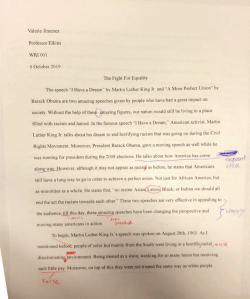
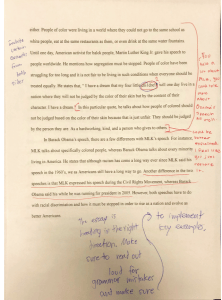
Final Draft for Essay #2 https://docs.google.com/document/d/1QtRHZNa-yxv3ZGAWEW8OrUWlZu8OD4Xmp14jg-B6BgM/edit
Weekly Response for “Malcolm X” https://docs.google.com/document/d/1dfgwOuhED0KNSf4VJtjthJ2r86FBk6MYODJOZRi12t4/edit
Rhetoric
In my journey through WRI 001, a problem I always faced was getting to know the purpose of my work. I only wrote words in my essay, but I never had a true story to tell my audience. I never had a purpose to why I was writing my essay and why my argument is important. The daily readings helped me identify the genre of every article and why every author’s argument was so powerful to the audience.
To explain, we were asked to read an article about how social media users present themselves online and real life. I really enjoyed reading this article because the author had a great use of tone in his words to conduct his argument. The author started off by talking about his own experience at a wedding, where a couple excused themselves in order to go back home and “relieve the babysitter.” However, hours later he found the couple at another party through a mutual friend’s post. The argument the author was trying to purpose was that we as social media users should be aware of what they post. Moreover, how curating a different persona in a certain platform can affect the user if they accidentally get caught by a certain person. This author had a persuasive article due to their choice of words and relating with the audience by telling them to watch out for what they do or who is recording for social media.
These types of articles helped me with my own writing style and how I can persuade my audience to agree with my points of view. Instead of stating examples from my life in a formal essay, I personally like to give some background information about my purpose in order for my audience to relate to what I am trying to say. Finding the right genre, purpose, and audience can help change the reader’s point of view.
For instance, Martin Luther King’s speech was so impactful because of his situation during the time of segregation. He found the right audience and persuade his crowd by clearly stating his purpose of ending segregation once and for all.
Collaboration
Before WRI 001, I was always very timid when it came to speaking up in class. Like previously mentioned, reading in front of the class and presenting was something I was always hated in class. However, talking to my peers about certain article we read in class, peer editing, and talking about my findings helped me improve my speaking and critical thinking skills in class.
In WRI 001, we were given group readings where we all read out loud in class. At first, I hated this because my face usually gets very red when I read in front of people because I get very insecure whenever I cannot pronounce a certain word or lose my place. However, later on I became much more comfortable with it because most of the people in my class were probably feeling the same way as me. Later on, group readings were something I was comfortable with. I was not insecure about my reading ability. If anything, it helped me look back on the words I could not pronounce and I tried to look up the actual pronunciation and meaning behind the word just in case I would have to use the word again one day.
Peer editing was also a helpful tool because I was able to gain feedback from my fellow peers about my work. At first, I was scared my peers would judge my writing skills and make think my essays were terrible. However, these exercises were able to help me enhance my writing abilities because my peers were able to give me helpful feedback about my work and were able to tell me where I can improve on.
Reading to the class, peer editing, and talking to my fellow peers made me a more confident student. All of this gradually gave me the strength to present in front of the class. A group of classmates and I gave a powerpoint presentation about language, specifically, how slang words can affect a person if they start using it at a young age. We found out that this was not the case. Slang is just a way of expressing oneself and it does not affect anyone’s reading, writing, or speaking ability if used correctly.
Talking to my peers helped me gain more knowledge about my own findings. Obviously, we all have different opinions, so hearing what my peers had to say about certain topics enlightened me and made me think differently about my own opinions.
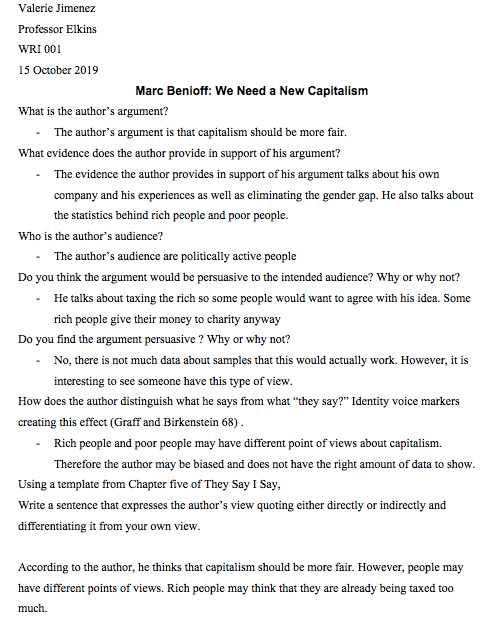
Research Ethics
The ability to properly cite the sources you find online is a crucial factor to avoid the act of plagiarism in an essay. It gives credit to other authors as well as making an essay more reliable if you use the right websites and authors. For instance, I was always taught to look up the author you are giving credit to just to make sure it is not a random person giving false information to the table.
The domain name can also affect the reliability of your work. In other words, the suffix of a website, (.edu, .gov, .mili). The domain gives entity to your work and becomes for credible. However, I would avoid getting my information from any blogs or any website that end with “.net’ in the domain. This information is not credible because the author is not sure who is giving them this information.
The use of Wikipedia is a great example of this because random people can go on this website and edit the information that is provided on the website. It is important to get your information from research universities, government, military, etc. Using information from the news is also a reliable sources.
The correct MLA format is also a good way to organize the sources used in your essays. Personally, I was taught to always organize your cited sources in alphabetical order, as well as stating when the work was accessed with the respective date.
In WRI 001, I was able to apply this knowledge to correctly state my reliable sources. Moreover, I used the research database that UC Merced offers online. This allowed to find the correct sources I wanted in my essay. My journey this semester helped me realize how important it is to cite your sources. High school does not take the act of plagiarism too seriously. However, a student can suffer huge consequences if they do not cite their sources correctly, because then it would be an act of plagiarism which is a crime in school. I learned that every single author’s work you use in your work should be given the same amount of credit. It would not be fair if someone stole my work and used it as their own on their essays.
Below are examples of how I cited my sources on every essay I write.
Work Cited https://docs.google.com/document/d/10f5KTCL7rrTJUFz3ly-Vm2KTfIHl6Bj8boOYepRGHeg/edit
#2 https://docs.google.com/document/d/104tDSPT8_Hx8JA41phQshyv_cRtHQjj9I0VBxN3rte8/edit
Craft
Before WRI 001, my vocabulary was very limited. I wrote the same way I would speak to someone in person. However, my use of vocabulary gradually increased because of this class. For almost every class discussion, we were given time at the end of class to look up any word were not able to comprehend from any readings we had in class that day. We were separated into groups and incorporated at least three words with a definition and sentences included on a google doc that everyone had access too. This was actually a very helpful tool because I would go back to the google doc and try to memorize at one new word everyday. Moreover, I tried my best to implement it in any writings or in my everyday use of vocabulary. Towards the end of the semester we were able to put our skills to the test and guess the word with the correct definition.
Another way I tried to improve my vocabulary was subscribing to the word of the day provided by the well known website dictionary.com. Everyday I try to expand my limited vocabulary as best as I can. Growing up I did not have access to books, however, now that the internet is in my hands, I am able to use it for my own benefit. Expanding my vocabulary in this way has helped shape me into the writer I am today. When I craft my essays, I am usually just writing my essays freely. If I ever feel like I am using a word that is too simple. I try to find a synonym that can make my essay sound smoothly when it is being read out loud. I believe that using the correct choice of words is crucial to make an essay sound as beautiful as it can possibly be.
Craft https://docs.google.com/document/d/1rectuCNBpXQDkcfy0oYMmGhqP4yoSsoVvkXKBBLREJY/edit
Introduce Yourself (Example Post)
This is an example post, originally published as part of Blogging University. Enroll in one of our ten programs, and start your blog right.
You’re going to publish a post today. Don’t worry about how your blog looks. Don’t worry if you haven’t given it a name yet, or you’re feeling overwhelmed. Just click the “New Post” button, and tell us why you’re here.
Why do this?
- Because it gives new readers context. What are you about? Why should they read your blog?
- Because it will help you focus you own ideas about your blog and what you’d like to do with it.
The post can be short or long, a personal intro to your life or a bloggy mission statement, a manifesto for the future or a simple outline of your the types of things you hope to publish.
To help you get started, here are a few questions:
- Why are you blogging publicly, rather than keeping a personal journal?
- What topics do you think you’ll write about?
- Who would you love to connect with via your blog?
- If you blog successfully throughout the next year, what would you hope to have accomplished?
You’re not locked into any of this; one of the wonderful things about blogs is how they constantly evolve as we learn, grow, and interact with one another — but it’s good to know where and why you started, and articulating your goals may just give you a few other post ideas.
Can’t think how to get started? Just write the first thing that pops into your head. Anne Lamott, author of a book on writing we love, says that you need to give yourself permission to write a “crappy first draft”. Anne makes a great point — just start writing, and worry about editing it later.
When you’re ready to publish, give your post three to five tags that describe your blog’s focus — writing, photography, fiction, parenting, food, cars, movies, sports, whatever. These tags will help others who care about your topics find you in the Reader. Make sure one of the tags is “zerotohero,” so other new bloggers can find you, too.
 Education